
Author
VBVMI StaffAccess all of our teaching materials through our smartphone apps conveniently and quickly.
Author
VBVMI StaffCan you explain what the "Kingdom of God" is in the Bible?
The term "Kingdom of God" has been interpreted to mean many things. Typically, Bible students either believe the Kingdom is a literal, physical time and place or is merely a metaphor for something else. Within these two broad categories, there are multiple variants of belief. For example, some who take a literal view of the Kingdom believe it is present on earth today, while others view it to be a future time and place on the earth, while still others view it to be a combination of both a present Kingdom and a future Kingdom.
VBVM hold to a literal view of Scripture wherever possible, including in this case. Specifically, we understand Jesus to teach about His Kingdom in the four ways, including a literal sense of a future time and place and people. The fulfillment of the Kingdom will occur in the 1,000-year reign of Christ on Earth following His return to Earth at the end of the Tribulation (Rev 19 & 20).
For a complete explanation of the four ways the Bible uses the term kingdom, please read our article Kingdom Come.
In its most literal sense, the Kingdom is a place Christ will occupy the throne of David and rule over Jerusalem, the Jewish nation and over all nations of the Earth. He rules until all things have been placed under subjection to Himself at the end of the 1,000 years (1Cor 15:28). We believe the Bible precludes any other interpretation or understanding of God's Kingdom.
It's important to remember that Jesus spoke of a literal Kingdom. For example, in Luke 22:18, Jesus says:
This statement only makes sense when interpreted in light of a literal, physical Kingdom to come. If His kingdom is a literal reign, then like any kingdom it must consist of three things: a king, a land with specific borders, and a people to rule over. The Bible gives us all three elements when it describes Christ's Kingdom. First, many, many places in Scripture testify to the plain fact that Jesus is the King of God's Kingdom, including His own words in Matt 27:11:
Now Jesus stood before the governor, and the governor questioned Him, saying, “Are You the King of the Jews?” And Jesus said to him, “ It is as you say.”
Secondly, Scripture makes clear that the people of the King are the Jewish nation. Isaiah 11 and Deuteronomy 30 (among many other places in Scripture) make clear that the Christ is the King promised to rule over Israel. Because of Israel's disobedience, however, the Gentile nations are being grafted into these promises to share in the kingdom of Israel and the opportunity to know their King. Nevertheless, the Gentiles will never replace or substitute for the Jewish subjects of Christ's rule, who have been promised to live in the Kingdom. We are always to be "a strange people" who have been invited to join the kingdom as Christ's Bride (Rom 11:11-36).
Third, the land Christ will rule over includes the entire world, but He rules from Zion, and Jerusalem Scripture says. The land of Christ's Kingdom includes the whole world, but it is specifically headquartered in Jerusalem, and since this has not happened as yet, we know the Kingdom is a future event to today.
Christ our King didn't set up His literal kingdom on Earth and rule over the Jewish nation at His first coming, because though Jesus declared many times in the Gospels that HIs kingdom was "at hand," His people rejected Him. So Jesus departed for a time while He waits for the Jewish people to reverse that decision. We see Him make this declaration in Luke 13:34-35:
Because the King was rejected by His people, He declined to reign at this first opportunity. Instead, He went to the cross and then entrusted the message of the coming kingdom (i.e., the Gospel) with His Church so we might carry it forward until His return. So, today the kingdom is still "at hand," just as it was when Jesus came Himself. It will remain "at hand" until the King returns to establish the Kingdom in fact (Heb 3:7-13).
Jesus describes this situation of a delayed kingdom in the parable of the minas:
We see clearly from this parable that the kingdom was not intended to appear at Jesus' first coming (see Luke 19:11). Rather, the arrival of the kingdom was delayed until Jesus' return, pictured by the Master's return in Luke 19:15. Likewise, we today await the King's return so He may rule over His physical kingdom and subjects in a future day.
We have many in-depth teachings available online that address this topic. In particular, our teaching through the Gospel of Luke examines Jesus' own statements concerning the Kingdom at many points, as does our teaching through Revelation and our on-going study through Isaiah.
Scripture quotations taken from the (NASB®) New American Standard Bible®, Copyright © 1995, 2020 by The Lockman Foundation. Used by permission. All rights reserved. www.lockman.org
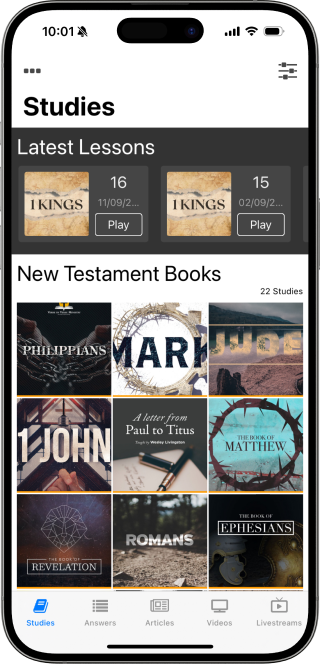
Access all of our teaching materials through our smartphone apps conveniently and quickly.