Author
VBVMI StaffAccess all of our teaching materials through our smartphone apps conveniently and quickly.
Author
VBVMI Staff
I am having trouble grasping Romans Chapter 12 and the decreasing priorities of sanctification. Can you please expand?
We assure you there is no "one shoe fits all" when it comes to ones sanctification. There is no way to master sanctification on a personal level, within the body of Christ or with the world. Simply put, God works out each believer's sanctification in various and different ways. However, scripture is clear that the Holy Spirit is responsible for giving each believer a new heart and guiding us to be more Christ like every single day:
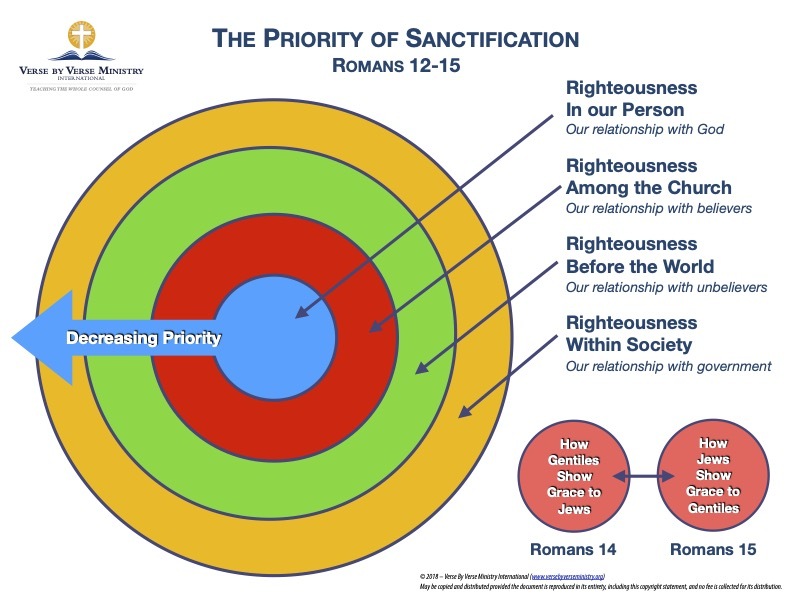
Concerning Romans Chapter 12-15 and what type of sanctifying work God does in a believer's life, let us first look at the chart provided in our Romans teaching:
As mentioned before, there is no step by step prescription that a believer can follow to become "more sanctified". This is a lifelong process of the Holy Spirit and a continual dying to self every single day of our lives.
However, the center of the bullseye should always be our highest priority; our relationship the One Who sanctifies us. As the rings move outward, the priority diminishes. For example, our relationship with God is the most important area of sanctification and a higher priority than our relationships with the church or the world. Consequently, as we attend to our personal holiness with God, we also become better equipped to attend to the needs of the outer rings. Obviously, we never “finish” working on a given ring because sanctification of any kind is a process that never ends. For instance, we will always battle sin within ourselves and we will always work on improving our relationships in the body of Christ, etc.
Nevertheless, as we gain some measure of strength in one ring, we begin to benefit from that strength as we work in other rings. A Christian cannot short circuit this process in Romans 12 through 15. We cannot skip over an inner ring and expect to succeed in outer rings. For example, the believer who has not made an effort to grow in the grace and knowledge of Jesus Christ is not well-prepared to serve fellow believers. Likewise, if we don’t strive for holiness in our relationships within the body of Christ (where we have a safe environment to fail and learn), how will we win unbelievers? Finally, we work on these relationships in the power of the Spirit to convict, teach and guide us through this process. We can never achieve results in our own power, therefore, we must follow the Spirit’s leading, allowing Him to change our hearts over time.
When we pursue sanctification according to Paul’s pattern, we gain a biblical tool for resolving conflicts in our obedience priorities; e.g. if serving God in our personal righteousness comes into conflict with the government’s demands upon us, who do we obey? According to Paul’s prioritized system, we must obey God over government as Paul teaches in Romans 13. Or if our commitment to the body of Christ conflicts with our obligations to the world, we give priority to our Church relationships over the world. This is a hard principal to follow when our obligation is to a brother/sister in Christ over an unbeliever who is our own flesh and blood, but according to Paul, our relationship with other believers always takes precedence over any unbeliever.
Furthermore, these chapters are much more than merely a laundry list of rights and wrongs…they are the masterplan for how to live for Christ.
So what are practical ways you can notice sanctification in your own walk?
Our personal sanctification matters to God by way of glorifying Him to achieving the mission of the church. Paul urges us to pursue holiness by depending on God’s mercy rather than seeking to become holy in our own power:
Regrettably, we prefer to seek holiness without relying on the mercy of God, typically by making our own plans for how to be holy.
If you want to escape a "surface" Christian life, seek righteousness in the right way, according to God’s mercy, Paul tells us to present our sinful bodies to Christ as a living and holy sacrifice. Paul’s saying that we must make a daily decision to serve God with our lives, submitting ourselves to God continuously thereafter. Simply put, it means placing the goal of pleasing the Lord ahead of pleasing ourselves or anyone else. We are called to be holy as Christ was holy:
This lifelong process of becoming more Christ-like is progressive sanctification. It is God Who sanctifies us through the Holy Spirit and His Word (1 Thessalonians 5:23). A believer builds a relationship with God by studying and obeying God's Word, by conversation with Him through prayer, by connecting in relationship with other Christians. Moreover, a born-again Christian has everything they need to accomplish God's task of sanctification:
These scriptures proclaim the sufficiency of God's word and work in our lives, through the Holy Spirit living in us. Additionally, the written word teaches us how to be Christ-like and move away from a sinful lifestyle and habits. The Apostle Peter explains through diving illumination the process and benefit of sanctification:
Jesus says those who love Him obey Him and do the will of God just as He did the will of the Father:
Interestingly, according to Hebrews, Jesus had to learn obedience through suffering:
Our struggles (trials, suffering, persecution) are opportunities for obedience which produces sanctification. As we persevere through whatever life throws at us, the more we will begin to look like our Savior:
It is especially important that we follow through with what James reads in verse 5; to ask God for wisdom... and it will be given to him. This is a promise.
Moreover, the Bible says God is the author and perfecter of our faith, therefore every believer has what they need in order to be sanctified daily:
Finally, brethren, hold fast to what Paul explains in his letter to Philippi:
When something happens, we have the opportunity to make a conscious choice to turn to God, to His Word, to prayer – or to be lead by our emotions or the world.
We would encourage those who desire to seek righteousness and knowledge of God, to dive into the word through the study. Also know that it is the Holy Spirit within us Who conforms us to Christ, Who sanctifies us and through Whom we manifest the fruit of the Spirit:
Scripture quotations taken from the (NASB®) New American Standard Bible®, Copyright © 1995, 2020 by The Lockman Foundation. Used by permission. All rights reserved. www.lockman.org
Access all of our teaching materials through our smartphone apps conveniently and quickly.


