Author
VBVMI StaffAccess all of our teaching materials through our smartphone apps conveniently and quickly.
Author
VBVMI StaffIn Matthew 13:41, Christ sends out angels to gather all the causes (people) of sin and lawlessness. Later in Matthew 25 Christ divides the sheep from the goats. Are these two separate groups of people? How do they play out during the Second Coming?
In Matthew 13 Jesus speaks in parable about the Kingdom and the end of the age. His descriptions are general and veiled through the use of symbols. Later in Matthew 24-25, Jesus addressed these same topics in greater detail and in simpler language. By comparing the two, we find that Matthew 13 and Matthew 24-25 are telling the same story.
In the case of Matthew 13, Jesus says:
The outline Jesus gives is broad, but the pieces are clear to see. At the end of the age (v.40) Jesus returns (v.41). Part of the events surrounding His return is the dispatching of His angels to gather people from wherever they exist on Earth. Among those collected will be those who are lawless (i.e., unbelieving), and these will be thrown into Hades (v.42).
Looking at Matthew 24-25, we see the same set of circumstances described, though in greater detail:
Again, Jesus says that at the end of the age after the Tribulation is concluded He will return (vs.29-30), and then His angels will go forth to gather people from around the earth. In Matthew 13 the Lord said the unbelievers would be collected, and now in Matthew 24 He says that the believers (the elect) will also be collected. Therefore, we understand that all humanity is being collected at this point in time, though for different outcomes.
Furthermore, after this collection Jesus says that He will judge all humanity present so that only believers may enter the Kingdom. Since all were collected, then there must by necessity be a separating of one from another (i.e., “sheep" vs. “goats"). This moment isn’t a distinct and separate judgment from the one discussed in Matthew 13, but rather Matthew 24-25 offers a detailed explanation of the same judgment. Matthew 13 limits discussion to the situation for unbelievers, while Matthew 24 gives the full account for both groups.
For a more detailed explanation of these matters, please listen to our Revelation Bible study available here.
Scripture quotations taken from the (NASB®) New American Standard Bible®, Copyright © 1995, 2020 by The Lockman Foundation. Used by permission. All rights reserved. www.lockman.org
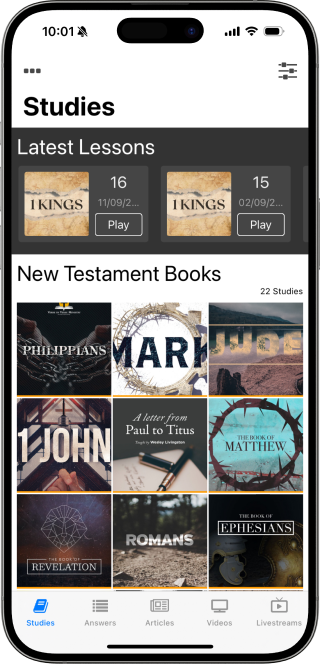
Access all of our teaching materials through our smartphone apps conveniently and quickly.