



Taught by
Stephen Armstrong
Taught by
Stephen ArmstrongPaul’s first missionary journey with Barnabas is almost complete
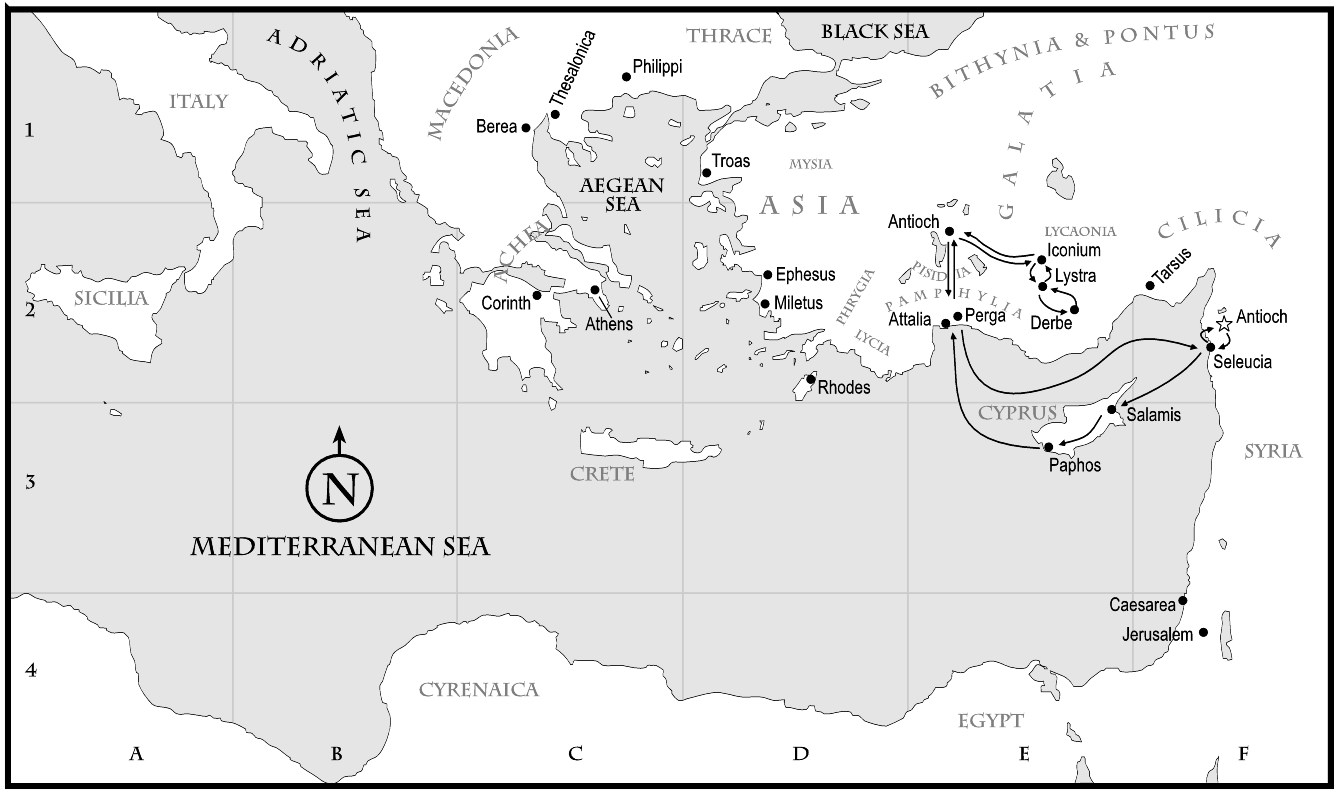
Refer to the map of this initial journey
The journey has lasted nearly 2 years as best we can tell
After his first journey Paul wrote his first epistle, Galatians, shortly after attending the council of Jerusalem
Having just established a series of new Gentile churches, it makes sense that Paul would have been moved to write letters to these churches
The letter to the Galatians is written to the churches of Galatia, which refers to the churches Paul established in this first journey
And as the trip nears its conclusion, the apostles reach a few more cities, largely without opposition
As we left last week, Paul had just recovered from his stoning
And He leaves the next day on a trip to the next town, Derbe
In Derbe they make many converts and establish yet another Gentile church
Then they begin to retrace their steps back through the various churches in Asia Minor where they have established beachheads for the gospel
From Derbe they head back to Lystra, Iconium and Antioch
Antioch here is not the Antioch where the first church was established
This is a different Antioch in modern-day Turkey (see map)
As they revisit each church, Paul and Barnabas bring a message of comfort
Luke sums the message in v.22
Many tribulations will be the common uniting experience of the faith
We must imagine that after Paul and Barnabas left each church, the persecution that fell upon the apostles transferred to the new believers
Either from Jews of Gentiles, the early believers were under attack
And these new believers were probably unprepared for this type of religious persecution
Such persecution was probably rare and they may have misunderstood it’s meaning
Perhaps it meant that God was unhappy or that the faith was not true?
Paul explains that trials and tribulations should be expected
And no doubt Paul pointed to his own experience as proof
On the return trip, Paul leaves each church with leaders
He appoints elders
And Paul appointed them, they were not elected
We’ll never see a congregation form of church government in Scripture
The Biblical model is always a process of appointment by men who received their leadership roles by similar appointment
The church has always moved forward at the hands of men and women who answer the Spirit’s call and anointing
Then are sent by elders to establish a new work
Once the work takes hold, the leader establishes new leaders, and so on
The Bible never supports the view that there is a pope or utmost church leader on earth
But there is a chain of anointing and commissioning expected
We have “fathers” in the faith and church leaders who have been established by the Spirit’s anointing and confirmed by earlier leaders
Secondly, the elders are plural in each church
The concept of a single pastor-led model is not Biblical either
While a new church may rely on a single leader for a time, as the church in Ephesus did with Timothy or Titus
But as the church grows, the expectation becomes that the leader appoint co-leaders
Finally, Paul and Barnabas commend these new believers to the Lord
When we think about how hard it was to communicate or travel over long distances
And then considered the threats and challenges these new churches must have faced as Gentiles in the early church
No NT, no large library of Christian writing or culture
No support structure and history in the faith
We have to marvel that the church survived at all...until we remember that it exists and grows by the power of God
And it was upon this truth that Paul rested as well
He commends the church to the Lord because he knows that the church is always in His hands
And Paul and Barnabas will be a long way away for many years and must depend on the Lord to take care of these believers
Paul wraps up his victory lap in Perga and then heads over to Attalia
Finally, from there he sails back to Antioch of Syria where the first church is still present and growing
And they commend Paul and Barnabas on all they have accomplished and on the work of the Lord in opening a door for Gentiles
Now we transition into chapter 15 to learn of an early challenge to the orthodoxy of the church
The scene begins in Antioch of Syria where Paul and Barnabas are still ministering
The men cam from Judea and were of the circumcision party
These were the same men who had challenged Peter for being willing to enter the home of a Gentile
They come to Antioch of their own initiative
The fact they decide to travel from Judea all the way to Syria to confront Paul’s growing ministry to the Gentiles tells you how much this issue has become THE issue for them
In my personal experience, I run into this kind of obsessive single-mindedness within the church
I meet and individual or small group of people who define their Christian life and purpose by a single theme or idea
Sometimes the theme is hyper national patriotism
Or Gentiles trying to mimic or adopt Jewish practices and lifestyle
Or natural remedies and healthy eating
Or whatever the fad of the week may be
The problem with this narrow focus is the way it creates selective attention
When we adopt a “thing” we see everything through the lens of that issue
Alistair Begg tells a story of an American pastor who asked him what his “thing” was...
And our focus leads to an unbalanced and uneven Christian maturing...or even a failure to mature
You will only attend to this topic of interest and ignore other important areas of Christian growth
More troubling, this narrow focus can lead in extreme cases to a warped theology and even a false gospel
This has happened here
The desire to cherish a long-standing Jewish mandate leads to a expectation that Gentiles adopt it as well
And to force this outcome, these men teach that God Himself has made it a requirement for acceptance into the Christian faith
In other words, a work was required to be saved
This same problem was also happening in other Gentile churches
While in Antioch the problem is circumcision, in Galatia it was the Law as a whole
Men were teaching that keeping the Law was required salvation
Which is why Paul wrote the letter of Galatians while in Antioch
Listen to Paul’s opening words in that letter...
When these men reach Antioch, Paul and Barnabas confront these men
And they strongly resist this teaching
And they debate these men at length
The word for dissension means strife in Greek
The unity of Antioch that Luke described earlier is now threatened by wrong teaching
Knowing Paul’s ability and track record in debating false teaching, it’s surprising that the church didn’t immediately accept Paul’s point of view
But for the benefit of the church as a whole, God causes the argument to simmer for a while until the leaders in the church determine a course of action
The church leaders decide that the issue should be resolved by a meeting in Jerusalem with the Apostles as a whole
Remember, that Peter has the keys to the kingdom and he had the power to bind and loose on earth as in heaven
This refers to the power to permit or forbid certain practices or beliefs for the purpose of setting church doctrine and practice
The discussion must move to Jerusalem for the apostles can meet and include Peter for the final decision
So they send Paul, Barnabas, and other men
We know from Galatians that Paul took Titus
And we can assume that some representatives of the other point of view attend as well
It’s noteworthy that the leaders in this church do not include Paul and Barnabas at this point
They submit themselves to the authority of the elders
What a demonstration of submission to authority Paul and Barnabas demonstrate here
They are the founding members of the church and Apostles no less
They might have demanded the elders kick out the trouble makers and simply accept the Apostles’ word as a final answer
Instead, they follow the instructions of the elders
Since they have to take a long journey south through Phoenicia, the Galilee and Samaria, the Apostles take the opportunity to inform the church of all that was happening among the Gentiles
The Phoenician church were Gentiles while the Samaritan church was Samaritans
Both of these groups would have been greatly encouraged to hear of other Gentiles joining the church
But as they progressed to Jerusalem, Paul would have encountered more and more Jewish churched
And they probably reacted differently to the news
And it must have concerned and excited the young Jewish church
Though is was a sign of the power of the Gospel
And it brought the Jews comfort to know that they were not along
Instead, they were begin joined by the world of Gentiles into faith
Yet it brought concerns too
What would happen to the Jewish culture within the early church?
Would the Jewish church become overwhelmed by Gentiles
And would the Jewish traditions and customs be lost?
This is likely at the core of why the Party of the Circumcision was trying to convert Gentiles to Judaism first
And out of fear, they were trying to stop the inevitable
They were resisting God’s desire to create a Gentile bride for Christ
We now see that motive in the first meeting of the Apostles in Jerusalem
After giving their initial report on the rapid growth of the church among Gentiles, certain men objected
A sect of the Pharisees, which refers to the Party of the Circumcision from Acts 11:2
They demand both circumcision and the following of the Law
It makes sense that Pharisees would expect submission to the Law since they themselves defined themselves by their scrupulous adherence to the Law
This is an example narrow focus on a single theme of Christian living
And in this case, the theme wasn’t a Christian theme
It’s an unChristian theme that distorts the Gospel
In chapter 2 of his letter to Galatia, Paul describes how this meeting began
He arrived with Barnabas and Titus
He immediately met with Peter, James and John to see how they felt about the matter
Paul says he submitted to them the story of how he preached the Gospel to the Gentiles
When Paul says “how” he means not merely that the Gentiles were receiving the Gospel...that wasn’t news to anyone
Rather, he means of how he preached faith without works was the mean to salvation
Paul wanted to find out if Peter and the rest of the Apostles were preaching the same Gospel
Paul’s private meeting results in the Apostles agreeing that this is the true Gospel and they plan in secret for how they will conduct the public meeting with the Gentiles and others
When that meeting takes place, the Apostles are already of one mind to reject the Pharisees call for Gentiles to submit to circumcision and following the Law
Luke says a meeting is held to consider the demands of the Pharisees
Luke indicates in v.7 there was much debate, but the debate wasn’t among the Apostles
It was among the Gentiles and elders and Pharisees
According to Galatians 2, the Apostles have already met and agreed on a course of action
The Apostles observed and listened
Finally, we finally see Peter end the debate and stand up and make his decision known
By allowing the room to voice opinions first, the Apostles gain a useful advantage
First, they learn who among the prominent men of the church understand the Gospel properly and who don’t
Secondly, they give the body a chance to feel a part of the process and helps cement their acceptance of the Apostles’ decree
Peter speaks for the last time in the book of Acts
Peter begins by reminding the crowd that it was God Himself Who made a choice over 10 years earlier to include the Gentiles in the church
The circumstances of Cornelius‘ salvation made clear to everyone that it was God Who decided to make this happen
And that choice was made clearest by the fact that God visibly gave Gentiles the same Spirit
Here again we see the unique significance for God making the arrival of the Holy Spirit visible at times during the early church
It was a watershed moment when Gentiles believed, and God made sure everyone knew that the Spirit had arrived
Peter goes on to point out that the arrival of the Spirit resulted in a cleansing that was universal and common to both Gentile and Jew
And then Peter makes his turn with one of the most powerful statements against legalism in the Bible
First, he says why do they test God?
The word test here means that to doubt the Gentiles’ entrance into the church on the basis of faith alone would be to call into question God’s judgment in the matter
Since God Himself has made clear His intent to include Gentiles on the same terms He included the Jews already
When Pharisees asked Gentiles to do more than God required, they are testing God
Secondly, Peter compares the demands of the Pharisees as a yoke on the neck of the disciples
Notice that Peter uses the word disciple to refer to the Gentiles, clearly indicating Peter’s view that they are brothers in the faith
And he sees the requirements levied by the Pharisees as a yoke or burden
And Peter adds that not even the religiously observant Jew was capable of bearing this yoke successfully, referring to keeping the law
Peter’s statement is revealing because it indicates that the Pharisees in the church still believed they were keeping the Law
Peter correctly states that no one keeps the Law
Not the fathers and not us
So why think that the Gentiles could do it either?
Peter correctly states that salvation is by the grace of God alone
Grace means that God doesn’t recognize merit or achievement
He grants a pardon for His own purposes
When we ask someone to perform a work as part of their salvation that we ourselves are not even able to perform adequately, we are hypocrites and we sin
And in this case, the sin is made worse because the Pharisees insistence that this work is a requirement for salvation
Imagine how much damage would have been done to the early church is the Pharisees’ view had prevailed?
How many Gentiles would have found the Gospel to be “good news” if it included the requirement to be circumcised and perform the Law?
Similarly, when our presentation of the Gospel includes any suggestion of legalism, we test God
If we propose new rules for living, new standards of behavior, new cultural expectations, we repeat the sin of the Pharisee
We are adding works, whether intended or not, and we are acting hypocritically, since we ourselves invariably violate any rule we offer
Legalism is pernicious and easily overlooked in our evangelistic patterns
We should preach and teach salvation by grace through faith in Christ and nothing more
Any discussion of godly living and standard of conduct are premature for anyone who is considering the truth of the Gospel
And for those who have believed, any discussion of behavior must be divorced from a conversation of whether they are saved
They are saved by grace alone through faith alone
Behaviors are simply not a part of that conversation
Scripture quotations taken from the (NASB®) New American Standard Bible®, Copyright © 1995, 2020 by The Lockman Foundation. Used by permission. All rights reserved. www.lockman.org

Access all of our teaching materials through our smartphone apps conveniently and quickly.