

Taught by
Greg Driver
Taught by
Greg DriverWelcome back everyone, this morning – we begin a new book of the Bible.
I guess you wouldn’t call it a book, but rather a letter of the Bible because it's only 1 Chapter long.
A one-chapter letter, “a letter called Philemon”.
Now - as you have heard me say before, the introduction is in many ways – my favorite part of a new book or letter.
Primarily because context is the key when studying scripture.
Therefore, knowing who the letter was written to and more importantly why the letter was written is extremely important if you want to interpret the book or letter correctly.
And by the way – I really can’t emphasize this point enough, mainly because of all the Bible Bingo that goes around in our society today.
Where someone pulls out a verse of scripture and uses it as their “proof text” all for the purposes of proving or disproving a point.
The problem is, about 90 plus percent of the time the verse they are using is wrong because they missed the context of the writings.
A great example of what I am trying to convey shows up in several verses throughout the Bible and so, I choose a few this morning to prove what I am saying.
This verse was first on this list because it’s so frequently taken out of context.
Remember, this verse wasn’t written in a context of God speaking directly to you (the modern-day reader).
It was a promise God gave to His chosen people – the Jews.
In Jeremiah, God promises the Hebrews, who are being held captive in Babylon, that He will bring them freedom.
The “prosperity” mentioned here is about meeting their practical physical needs.
It’s not about modern readers magically becoming affluent just because they believe in God.
This verse also has a harsh edge when shared out of context — for example
For example – When someone has a chronic ailment, and then this verse is prescribed to offer “magical healing.”
Problem is, when a misunderstood promise doesn’t come to pass, people’s faith can be weakened.
Next on the list we have:
This verse shows up frequently in athletic environments, from Steph Curry writing the verse on his shoes, to Tim Tebow referencing the verse on his face stickers
The insinuation is that professional athletes will have a competitive edge because they believe in Jesus.
However, in context, Paul writes this statement while awaiting trial (and potential execution) for preaching about Jesus’ resurrection.
Paul’s encouraging the Philippian church to endure their suffering by remembering that Christ, who overcame death, is the source of their strength.
It’s about finding an inner strength when you’re enduring spiritual adversity, not about being magically blessed with an athletic or professional competitive edge.
Let’s do one more – and then we will move on
Accompanied by the quote “only God can judge me,” people may interpret this verse to mean that nobody has authority to assert that there’s clear right and wrong.
However, saying “only God can judge me” doesn’t come from Bible, it comes from a rap song!
If this verse meant that humans must stop judging each other, we ought to terminate our justice systems and simply trust God to intervene and punish people who commit crimes.
Certainly, our society’s stronger for establishing rules to govern what behavior we’ll tolerate and what must be stopped.
One reason many people avoid the church is because they’re bothered by hypocrisy and self-righteousness among believers.
To strengthen our witness, we need to root out the “holier-than-thou” attitudes, making it clear that everyone is welcome in our churches.
So, just remember what I’ve said – especially when someone quotes scripture – and tries to use it to back up a theological or doctrinal theory or concept.
When someone does this to me – I always say – let’s see if you are correct by “backing up and asking some fundamental questions.
“Let’s see if what you are saying still holds true after putting those verses into context!
All we must do to put their theory to the test is to ask the fundamental questions:
Who wrote the letter?
Who was it written to?
And why did they write the letter in the first place?
Or what issue or problem does the letter or book address in that particular verse?
And if you do that – you will be amazed at the outcome, which, generally speaking, has nothing to do with the individual’s theological theory or concept.
Moving on, so today we will begin our teaching on the letter of Philemon, and for most people, if you say – I am studying Philemon, they will say, “You are studying what?”
And that’s understandable, given the fact as I said earlier, this letter is only 25 verses long.
Having said that, as you know it’s nothing for us to extract up to 5 teachings out of one Chapter.
So, it could last longer than you think – or maybe not.
So, Philemon? Who in the world is Philemon?
Furthermore – who wrote this letter?
And why did they write it?
These are the questions we should be asking ourselves. So, let's answer them.
First – we will begin our journey – by answering the question who wrote it?
It was Paul.
Which by the way just a side-bar, if someone ever asks you who wrote a particular book in the New Testament and you don’t know the answer, you will have a better than 50 percent chance of getting it right if you say – Paul.
Kind of like penciling in “C” on standardized testing.
And why – Paul wrote 13-14 of the 27 books of the New Testament.
Which means Paul by himself, wrote most of the New Testament.
With John coming in second with 5 books or letters
So, Paul wrote Philemon, but who was he writing it to or maybe more importantly – why did he write it?
Paul wrote this letter to a man named Philemon – to “pacify” and or promote reconciliation between a slave (his slave, a man named Onesimus) and his master (this man known as Philemon).
Philemon was a Christian believed to have come to faith under Paul’s leadership.
Possibly while Paul was in Ephesus ministering.
So, Philemon was a believer – and he was a wealthy man.
A man who lived in Colossae (CO-LEE-SEE) – which of course, made him a Colossian.
And as with most wealthy people in those days, Philemon had slaves – or at least he had one slave.
And that slave was a man named Onesimus.
But what in the world does that have to do with Paul? And why would Paul write a letter to this man?
Well – it turns out, Onesimus wasn’t just any slave.
He was a runaway slave.
No one knows why he ran away specifically, but popular beliefs think he ran away, not because he was being treated poorly, but because Philemon gave him great freedom.
And I will elaborate on that a little bit later in our teaching.
So Onesimus ran away from Philemon, but where did he go?
To Rome.
Why did he go to Rome?
Once again, the belief is it would have been easier for him to fade into the crowd – because Rome at that time consisted of some 450K-500K people.
Now while he was there, he just so happened to run into Paul.
This may seem insignificant to you, but I assure you it’s not.
It was divine appointment.
I mean – think about it, Colossae was 1300 miles aways from Rome, and that’s as the crow flies.
Which would have meant you must catch a boat ride to go straight there
And so – that would have been like you walking from Nashville to Hartford Connecticut and arriving in a town of 500K people, when you were from a town of roughly 50K people.
Then of course, magically running into Paul – the man who led your master to Christ.
Coincidence – I don’t think so!
So, Philemon runs away to Rome – and runs into Paul. And there Paul leads him to the Lord as well, and from there we are told that Onesimus becomes a valuable helper to Paul.
And then Paul (at some point) discovers that Onesimus was slave who belongs to Philemon.
Even though, Paul desired to keep Onesimus with him, he felt a greater responsibility to return Onesimus to his master.
You see, Paul eternally knew – Onesimus needed to make things right with Philemon.
Paul and Onesimus also knew the dangers a slave faced when returning as a runaway.
Since slaves were generally considered property, which meant Paul had somewhat (in a sense) stolen Onesimus.
Or at least at a minimum – he harbored Philemon’s property.
So as I said earlier, Paul wrote this 25-verse letter to “pacify” Philemon and to promote reconciliation between a slave and his master.
Now, all this all seems simple enough, but one question I have is - How does this letter get delivered to Philemon?
It wasn’t by the Post Office – or Fedex or UPS.
It was hand delivered.
Which meant – it probably arrived earlier – than if the Post Office delivered it!
So, who delivered it?
Well – it was delivered by a man named Tychicus (Tit-ti kus) – but he wasn’t alone – he was accompanied by Onesimus as well.
And we will talk more about Tychicus later.
And so – with that background behind us, let’s dig into Philemon.
And here is what Paul wrote and my NASB 95 translation calls this section Salutation – (which is nothing more than a greeting!)
So Paul begins his opening salutation in a unique way, where He refers to himself a prisoner.
And just and FYI to you, the letter to Philemon is the only letter he wrote – in which he references himself this way.
In all his other writings he calls himself - either an apostle or bondservant of Jesus Christ.
But never a prisoner!
So, wonder what that’s all about?
Well – if you think about the context of this letter, I believe it is easy to arrive at the answer.
Just remember, who it was that Paul was writing to and what he was writing about.
He was writing this letter to Philemon on behalf of his run a way slave, Onesimus.
So, there is no doubt Paul is trying to make a connection with Philemon.
Another important item to remember is that Paul is writing this letter from prison.
A place where God put him, which gives him a distinct advantage when speaking about a prisoner and or slavery.
And by the way, the fact that God places him in prison – that experience is what allows him to relate to both Philemon and Onesimus.
It reinforces what James tells us in James 1:1-2 when he said the following:
Listen to what James wrote on the topic of trials and tribulations specifically – what they do for us.
So, the next time you experience various trials, trouble of any kind, when you are going through something.
Never forget – God is doing something in your life.
Preparing you – qualifying you is the way I like to put it – so that you can minister to others who have experienced the same type of trial and tribulation.
And sure enough, we see that pictured through the life of Paul.
The fact that Paul has been a prisoner and considers himself a slave of Jesus Christ has earned him the right and authority to speak on the matter.
And for that reason, it would be fitting for him to describe himself this way.
Because he himself (no doubt) understands what it means to be a prisoner and or bond servant i.e. a slave.
Basically, Paul is not asking Philemon for any type of measure of sacrifice – as one who knows nothing of sacrifice, but rather – he is speaking as a prisoner / a bondsman.
Pleading on behalf of another prisoner or bondsman whose story is the focus and burden of this letter.
And we will see that to be the case as Paul points to his own bonds, no less than six times in this brief letter.
Now, by considering Paul’s statement, the looming question for all of us sitting here today should be-
Do we see ourselves in this light?
Do we see ourselves as prisoners and or bondservants of Jesus Christ.
Before we say yes, let us consider what that means, because at its core – it means our life is not our own.
It belongs to God!
It been purchased with a price!
And we no longer own it!
And therefore, everything we do (actually - in everything we say and do) should be done with one thought in mind.
Is what I am doing pleasing my Master.
Or maybe even more than that, is what I am doing what my Master wants me to do.
That’s really what’s at the core of what it means to be a prisoner or bondservants at heart. Are we pleasing our Master?
By the way – I realize this is easier said than done, but it is accomplishable.
It is accomplishable if we are cognitive and aware of our position before Christ.
Meaning, it’s accomplishable if we have a correct view of ourselves.
Which is what?
Well – let’s allow Isaiah to tell us what that view should be.
Now, before I read this – I want you to think about the experience Isaiah is having here, because – if you realize the situation he finds himself in, that’s what will help you come to the realization of how insignificant we really are.
More specifically – how insignificant we will be when we stand before the God of creation.
Let me read it to you:
So, all you must do to see yourself in the correct light is to read Isaiah’s encounter with God.
We as humans all possess an element of pride in our conscious and or subconscious, and we all tend to see ourselves in the most favorable light possible.
But when you pause for a moment and think about it – think about what it’s going to be like – on the day you meet the Creator of the universe.
When you stand before God.
Isaiah’s account of this moment – will give you just a taste of that moment.
We don’t know exactly what it will be like, but I can assure you – based on all accounts of those who encountered God in the Bible, our encounter – upon our death – is not going to begin with us saying, Hey God – “ole buddy ole pal,”
How’s it been?
I am so glad to be here.
I’ve been waiting a long time to meet you.
That’s not what it’s going to be like.
In reality – it will begin with you hitting your knees and falling prostrate on your face.
An encounter with our Holy and Righteous God will be an encounter of trepidation met with extreme humility and reverence.
Which is how we should live each day, and some of us do a better job of this than others.
But none of us do it to the degree we should.
Humility is the key – when trying to please our Master – and as I said, this is tough.
Primarily – because our attention is consistently being held captive by the “shiny” things of this world.
So – how do we accomplishes this seemingly insurmountable feat – if we want to stay humble and remain in a consistent place of thankfulness and gratitude?
How do we do it? Anyone know?
I’ll let Paul give you the answer, and it shows up in Romans 12:1-3 – listen to what he says.
In verse 1 of Romans 12, Paul says – “I urge you” – which is one of the tenderest expressions in the Bible.
The Greek says – I exhort therefore you, brothers through the compassions of God.
Another way to say it is, I strongly encourage you!
Paul uses this expression, at least 50 times in his letters and the reason I am highlighting this word is because – Paul doesn’t put forth this statement as a command.
He isn’t forcing them to do this, which is where freewill enters the picture BTW
We have a choice in the matter. We can do it or not.
But if we do it – we must do so, with the correct attitude which is from a place of humility!
So – the concept is this – I am urging and encouraging you to do this, but it’s your choice.
You can live your life in an intentional and deliberate way, at least in your intent of living for Christ or you can skip it.
But if you skip it, your life lived out on this planet will not be a fulfilled one.
Matter a fact, your life will look a lot like the life of an unbeliever.
Which is what?
Confused – without understanding.
And without the Peace that only God can give.
The concept here is that of any sacrifice – it’s an all or nothing proposition.
Meaning – it’s not a partial sacrifice.
Paul wants us to present our bodies.
Our whole being.
Everything we have as a Holy Sacrifice.
And that and that alone – is all that will be acceptable before God.
When we do that, it’s at that point we have fulfilled our obligation to our Lord and Savior – hence our Spiritual Service of worship (as Paul calls it).
But how do we do that?
How do we present our bodies as a living and holy sacrifice?
Well – he tells us in verse 2 of Romans 12.
Once again, let’s talk freewill here. We are urged to do something. To not be conformed to this world.
But how do we do that? By staying out of it.
What does that mean?
It means stay out of it
Stay away from the things the world loves.
That’s how we please our Master – it’s by the choices we make with our time.
By the things we read – watch – participate in.
By what we allow to enter our minds.
One more time –
So – how do we become a living and holy sacrifice?
By refraining from participating in the things of this world.
And replacing that activity with something else.
Which is then what transforms us and or renews our mind!
I love the way Paul says this because it tells us a couple of things.
Number 1 – it tells us we can do what God has urged us to do
Which means it's accomplishable.
Number 2 – the way we accomplish it is by renewing our mind.
And this is where we will close because honestly – this is where we begin to grasp the concept of what it means to be a slave or prisoner or bondservant.
Which (as I said) is how we should see ourselves if we want to see ourselves in the correct light.
We must look into a Spiritual Mirror, and see ourselves not the way we imagine ourselves to be.
Rather we must see ourselves as the way we truly are.
Which is a people of unclean lips.
And the only way that can happen is when we study God's Word and He reveals Himself to us.
That’s what Paul means when he says, “But be transformed by the renewing of your mind”.
One quick note relating to Paul’s words here, I want you to notice – this is not a one-time thing.
Paul’s words convey to us that this is something ongoing – meaning we must do it repeatedly.
If we desire to stay in a right relationship with God, and this process is simple – yet complex at times.
If we want to be renewed in Christ – and become that living and holy sacrifice, it all begins by replacing the things of this world – with the things of God.
And for believers that thing of God is only one thing.
It’s His Word!
Because His Word is Him in Word Form!
Which means on a practical level, instead of watching something that would not please our Master, we must read or listen to something that is.
Which is tough – trust me I know.
Primarily because the things this world offers requires little to no sacrifice.
It’s easy to get caught up in the things of this world.
TV – Internet – our Phones.
Requires little to no effort.
Whereas the things of God require sacrifice.
It requires us to make an intentional and or conscious decision – specifically as it relates to what we will spend our time on.
Is it “Tik Tok” or “Facebook” or “Instagram” or whatever.
Or is it time in God’s Word studying or listening to sermons of Bible Teachers.
And so, let me just say as we close, Paul calls himself a prisoner because that’s what he was.
And that’s what we are.
God owns us – and our life is not our own, and his calling is our calling.
We are no different!
Amen – Amen!
Scripture quotations taken from the (NASB®) New American Standard Bible®, Copyright © 1995, 2020 by The Lockman Foundation. Used by permission. All rights reserved. www.lockman.org
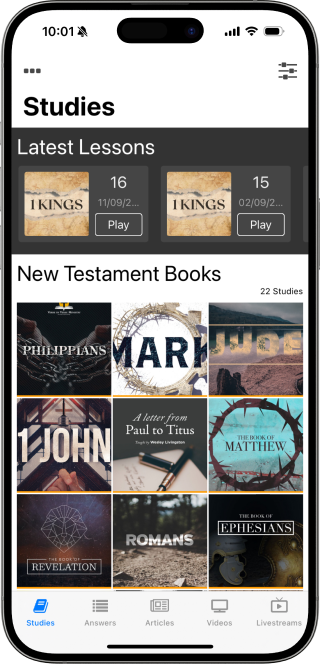
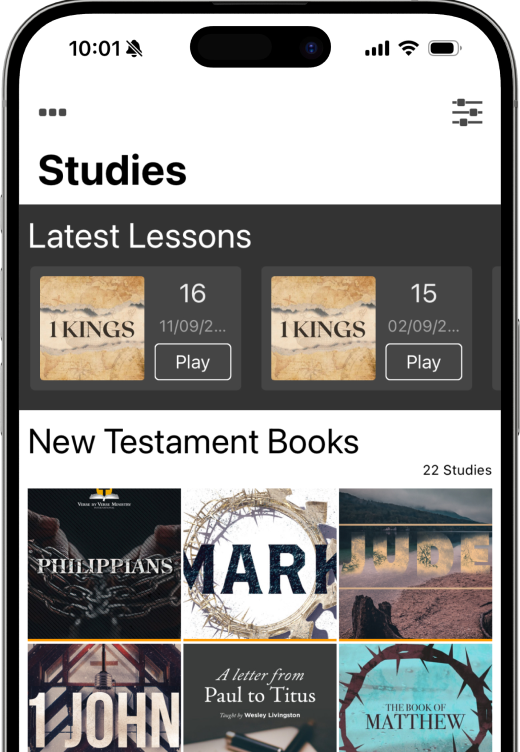
Access all of our teaching materials through our smartphone apps conveniently and quickly.