





Written by
Sofi Smith
Written by
Sofi SmithScripture: Romans 10:14-21
Big Idea:
Israel’s unbelief is not because of a misunderstanding, but because God chose to show mercy to Gentiles while preserving only a believing remnant in Israel.
Call to Action:
There are still Jews today who reject Jesus. This week let's focus on praying for these people.
Family Action:
Talk with your child about Israel (show it on a map) and how God used them to bring mercy to Gentiles—and will one day restore Israel.
Bible Drills (Memorization of OT & NT Book order)
Guide the children to Romans 10:14-21 in the Bible. (Help them as needed, NT vs OT)
Say: We are going to continue through Paul's letter to the church of Rome.
We will learn that the gospel is God’s power to save everyone who believes, and we should never be ashamed of Jesus.
Read aloud. (Ask kids to start their pointer fingers on V14 and follow along)
Review:
vv. 8:26-39 Nothing can separate me from God!
vv. 9:1-13 Did God break His Promises to save Israel (Israel's Past History)
vv. 9:14-33 God’s Sovereign over ALL, and will not fail.
vv. 10:1-13 Trusting Jesus Is the Way, Jesus the stumbling block (Israel’s Present State)
vv. 10:14-21 Is this a Big Misunderstanding, that Israel missed Messiah? (Israel’s Present State)
What do you think God asks us to do to be saved—try harder or believe in Jesus?→ Explain your answers!
Notes:
Romans 9 reminds us that God is always faithful and fully in control of His mercy.
Paul began his defense by explaining that throughout Israel’s history, the Lord selected some for His mercy while passing over others (Isaac & Ishmael; Esau & Jacob)
Though Israel rejected Jesus, God used this to bring salvation to the Gentiles, while still preserving a faithful remnant of Israel—proving He never breaks His promises.
As Romans 10 opens, Paul asks an important question:
Is God being fair to Israel?
He explains that Israel’s problem was not a lack of effort, but that they pursued righteousness through the Law instead of faith in Jesus. Now, Paul moves on to explain Israel’s continued rejection of Christ—and how salvation is freely offered to anyone who believes.
Israel’s rejection of Jesus is not because God failed to keep His promises, but because their hearts were hard.
God clearly showed Israel the way to be right with Him, but they chose to trust their own goodness instead of Jesus.
And this leads to the third question Paul answers: Did Israel really have enough chance to understand that Jesus was their Messiah, or was God unfair by not explaining it clearly enough?
Was this a huge misunderstanding?
V14-17 How will Israel believe, if they don’t know Him?
Paul knows his Jewish readers are wondering:
“Why hasn’t Israel believed in Jesus yet?” (v.14)
You can’t call on Jesus unless you believe
Some might think the problem is simple:
Maybe Israel didn’t hear clearly (v.14)
You can’t believe unless you hear about Him
Maybe no one explained it well (v.14)
You can’t hear unless someone tells you
Maybe God didn’t send the right messengers (v.15)
And no one tells unless God sends them
Paul asks those questions for them—not because he agrees, but so he can answer them.
But God did send messengers. (Through His word and Prophets)
God did give Israel the message. (Through His word and Prophets)
The Problem:
The Good News was preached (By the Prophets & in the word)
Some Jews did believe (the remnant), but most chose not to listen
Isaiah, the Prophet to Israel, said this would happen: Many would hear the message; But few would believe it. (Isaiah 52:15/ 53:1)
So the problem was not a lack of information; the problem was hard hearts
Why faith happens or doesn’t (v.16-17) — we learned back in Romans 9
In human terms, faith comes by hearing the Gospel message
But in spiritual terms, a person’s potential to understand what they hear is determined by the word of Christ, calling them.
Or we could say, the Lord determines who truly hears the message of the Gospel
And we have learned that Israel rejected this message and still does today
Kid Point: Faith comes from hearing, that is, hearing the Good News about Christ.
V18 Well, did Israel actually hear the message?
Paul answers one last set of excuses people might make for Israel:
“Maybe Israel never heard the message.”
“Maybe they didn’t understand what the Scriptures meant.”
Paul’s answer to both is clear: Yes, they heard. Yes, they understood.
Did Israel Hear? (v.18)
Paul quotes Psalm 19:4, which says God’s message goes out everywhere.
Israel had even more help:
God’s Word, God’s prophets, God’s promises
Israel had far more opportunity than the Gentiles to know the truth.
Kid Point: Faith comes from hearing, that is, hearing the Good News about Christ.
V19-20 Did Israel Understand?
Paul quotes Moses, showing that God already said Gentiles would believe—even though they weren’t looking for Him. (Deuteronomy 32:21)
Gentiles would find the Messiah first, and Israel would see it happen.
Jealousy: this kept Israel’s hope for a Messiah alive by seeing the Gentiles have a Savior, but still, most refused to believe.
Further, Paul quotes Isaiah 65:1-5, saying God was found by people not looking for Him. (Gentiles)
Israel wasn’t confused about who Jesus claimed to be. He said He was the Messiah, God, sent from God to them.
They rejected Him anyway.
Kid Point: The people of Israel understood—and rejected Him anyway.
V21 God’s Open Arms
Paul ends with a powerful picture from Isaiah (Isaiah 65:2):
God held out His arms to Israel all day long
But they were disobedient and rebellious
God told Israel:
Where the Messiah would be born
When he would come
What family He would come from
How He would die
and how to be saved—by faith
Nothing was hidden. Nothing was missing.
God kept every promise He made to Israel
He preserved a remnant who believed
He gave Israel more opportunities than anyone else (His word, Prophets, Jesus)
Kid Point: Israel remains without Christ—not because God failed, but because He did not grant mercy to the nation as a whole.
What must happen before someone can call on Jesus to be saved? (Paul wanted them to be saved. v.1)
Who did God send to share His words with Israel? (Prophets, Paul quotes many of them through vv 14-21)
Did Israel hear and understand God’s message? (Yes, they heard it clearly and understood it. vv18-19)
Why does Paul ask so many questions in verses 14–15? (He is showing that God made sure Israel heard the message, so the problem wasn’t a lack of information. v14-15)
Why did Gentiles believe even though they weren’t looking for God? (Because God chose to show Himself to them by His mercy because of Israel's hard hearts. v20)
Why did many people in Israel still reject Jesus? (They were disobedient and refused to trust God by faith, even though he extended mercy to them over and over. v21)
What does this passage teach us about sharing the Gospel? (God wants us to tell others about Jesus, even though only He can open hearts. vv.15,17)
What warning does Israel’s story give us? (Knowing about God is not enough—we must respond in faith and obedience. v21)
How does it make you feel to know you are saved because God chose to show you mercy? (Open for discussion)
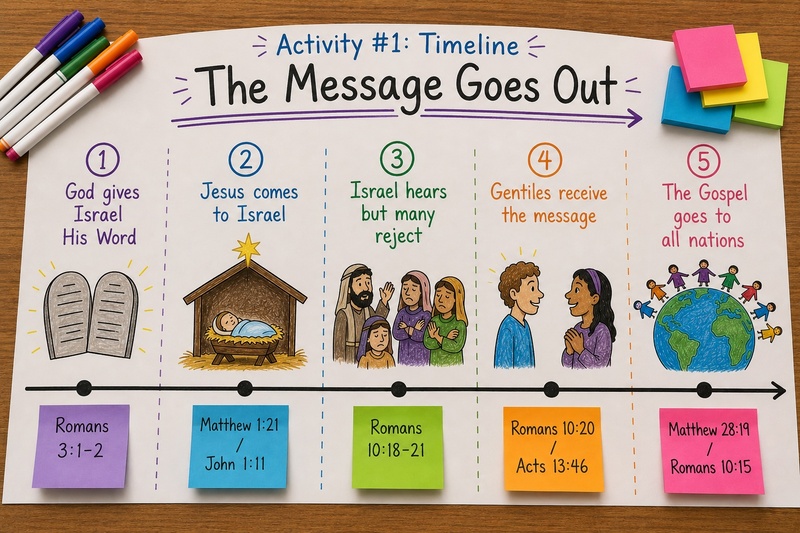
1: Craft
Timeline: “The Message Goes Out”
Materials needed:
Long paper or poster board for each child 6x18ish
Markers
Sticky notes for scripture
Instructions:
Create a timeline showing how God revealed His Word and carried out His plan of salvation, as explained in Romans. Include the key Scripture references and draw a picture for each event to illustrate what is happening. As you build your timeline, notice how every step reveals that God is always at work, faithfully accomplishing His promises. From His covenant with Israel to the spread of the Gospel to the nations, Scripture gives us a roadmap of God's unfolding plan for the world.
Students must include each stage with Scripture:
Key Understanding: God sent His message first to Israel, then to the world—just as He planned. The promise of Genesis 12:3

2: Memory Verse
Come up with moves
Romans 10:13 For “Everyone who calls on the name of the Lord will be saved.”
Jesus’ perfect life paid for the sins of all who believe. Jesus died on the cross as the punishment for sin. But Jesus did not stay dead, three days later He rose to life (resurrection) defeating the power of death. Believe, and you will be saved!
We are all sinful. We all deserve the consequence of sin- death.
Jesus is what saves us from the sin we all have in our bodies. And one day, he’ll even give us a new body.
God makes sure people hear about Jesus. (Romans 10:14-15).
Hearing the Gospel is how faith begins. (Romans 10:17).
Israel did hear and understand God’s message. (Romans 10:18-19).
Not everyone who hears the Good News believes it. (Romans 10:16).
God patiently reached out to Israel, even when they resisted. This is still going on today within Israel (Romans 10:21).
Scripture quotations are taken from the Holy Bible, New Living Translation, copyright ©1996, 2004, 2015 by Tyndale House Foundation. Used by permission of Tyndale House Publishers, Carol Stream, Illinois 60188. All rights reserved.