

Taught by
Stephen Armstrong
Taught by
Stephen ArmstrongThis will be the final part of the tabernacle’s design and furnishings
In reality, though, we’ve moved into an examination of the priesthood
In chapter 28 we learned about the priestly garb
And before that we learned about their work at the altar
As we move ahead, we remain focused on the priesthood and the tabernacle items associated with their service
In Chapters 29-30 we’ll study the consecration of the priests and then we’ll look at two more pieces of furniture in the tabernacle
The altar of incense and the laver are items associated with the priest’s role as representative of Israel
They been saved for this point in the narrative because they are so closely associated with the priests
As we look forward to chapter 31 in a future night, we’ll have a chance to see an interesting connection between Exodus to Genesis
The connection helps set the purpose and meaning of the time at the mountain in it’s proper perspective
And explain the significance of all that we’ve been studying in the tabernacle
Speaking of what follows, chapters 32-34 return to a narrative of Moses and Israel in the desert,
It centers on their sin with the golden calf and the aftermath of that sin
God’s judgment comes upon the people
And it also will cover Moses’ work of intercession to save the nation
This story also has a connection to Genesis, which we’ll see together
Let’s go to chapter 29 and study the consecration of the priests
The first 37 verses describe the consecration procedure
With such a long section of scripture, it’s helpful to start by summarizing the major parts
First, God is establishing a consecration ceremony for the priests of Israel
In v.35 God says this is for Aaron and his sons, meaning his descendants
This consecration ceremony was accomplished for each new generation of priests in Israel
This is the ceremony in which men are set apart for service to the Lord
The next thing we read will be the details of the consecration process, which consisted of three parts
First, the priests are ritually cleansed and dressed in their priestly garb and anointed by oil
Secondly, sacrifices are made on their behalf to remove sin prepare them to serve the Lord in holiness
Thirdly, the priests make a wave offering to the Lord of meat and bread and oil
Most of which is then burned as an offering to the Lord
But a part is saved to become the portion to sustain the priests, which is consumed in front of the tent of meeting
Then finally, this ceremony is repeated for seven days to complete the consecration
Following the consecration, the priests are then ready to serve the Lord
This ceremony was repeated for each new generation of Jewish priests throughout the history of the tabernacle and the temple
This ceremony is a beautiful picture of another kind of consecration, and we’re going to examine that picture as we go through the details
So looking at the details, let’s begin with the first section describing the cleansing, clothing and anointing of the priests
This section runs from vs.1-9
The first verses of the chapter describe the materials needed for the ceremony
The animals and cakes and wafers are used in the second section of this chapter, so we’ll set them aside for a moment
The washing, the oil and the clothing of the priests are the key items used in this first section
Moses begins with Aaron and all his sons at the doorway of the tent of meeting
This is the place immediately in front of the Holy Place
The Holy Place is the place where the priesthood served
Any Jew could enter the grounds, but only priests could serve the Lord in the Holy Place
So the priests stand at the entrance of the doorway to reflect the meaning of the ceremony, as their means of entering service before God
This chapter records God giving Moses the instructions while Moses stands with God on the top of the mountain
But the actual carrying out of these instructions are recorded in Leviticus 8
And in that chapter, Moses follows God’s instructions exactly as they are recorded here
After the priests are in the doorway, they are washed
This is not ordinary bathing, but a ritual washing intended to teach a point
The person who served God must be spiritually clean
And to picture God’s cleansing of these men, He demands they wash physically in a public way
So the first step of priestly service was to be cleansed
Having been cleansed, they were able to move forward into service
But washing wasn’t enough by itself
Secondly, the priests put on the priestly garments the Lord prescribed for their service
The High Priest, Aaron, is clothed first, followed by the other priests
This clothing designated the men as priests and set them apart
It gave them a new identity
So before the men could serve the Living God, they had to assume a new identity
Their new identity was evidenced by their new appearance
And that appearance communicated their new role and calling to serve in God’s house
Finally, the High Priest was anointed with oil on his head
The oil was a symbolic way of demonstrating the person had entered into a position of authority and power assigned by God
Priests were anointed
Prophets were anointed
Kings were anointed
So before these men could serve in God’s house, there must be an official anointing to signify that God authorized that service
With that authorization, the men served for a lifetime
The anointing was permanent
All of these steps have parallels for believers today, and I believe they are intended to picture the way God is working in the Church today
First, who are the priests of today?
It might be tempting to make a comparison between the ceremony we see in Exodus 29 and the establishing of Christian leaders or clergy
But that is an age-old mistake that Jesus refers to in Revelation as the Nicolaitan heresy
The heresy suggests that there is a Christian priesthood or clergy that are distinct or set apart from the rest of the body of Christ
But scripture says the opposite
All believers are consecrated priests of Jesus
Which means the comparison we are supposed to make in this chapter are between the priesthood of Israel and the priesthood of the believer today
Before we can serve God as priests in God’s house, we must be cleansed spiritually
The cleansing or washing away of our sins is accomplished by faith in Jesus Christ
In other words, our faith is the necessary prerequisite for any form of service as priest
And the instrument of that washing or cleansing is the Holy Spirit
Secondly, we must be clothed properly for service
And all believers are clothed by Christ, Who is our High Priest
Our clothing creates our identity, and begin clothed in Christ means walking in His righteousness and according to His example
How do you think the priest carried themselves after Moses placed their priestly garb upon them?
Can you imagine they walked a little taller, with a greater sense of burden and responsibility
Did they think twice about how they conducted themselves around others?
Likewise, we are called to walk differently having “put on” Christ
Finally, we are anointed for our service as priests by the indwelling of the Holy Spirit
We have all been anointed by the Holy Spirit, which empowers us for serving the Living God in His holy place
The power for our service is given to us by the Spirit
Our service to the Lord is not a matter of personal ability or careful planning or even effort
The power for service is entirely given to us by the Holy Spirit
Certainly, we must labor with the Spirit, or else we grieve Him
And this anointing is given to us not to make us feel important or to enflame our pride
Like the priests in the tabernacle, the anointing of God is intended to empower us to serve God’s people in God’s house
The gifts of the Spirit are tools we wield in service to the God
We have been consecrated by the Spirit, set apart to be Christ’s servants
So by faith in Christ, we are commissioned into the priestly service of God, clothed with Christ, and empowered by Spirit
But before we can serve to the fullest, there are steps that must be taken to prepare us for that service
In this second section, a series of sacrifices are performed
A bull and two rams are sacrificed on the altar
Before the animals are sacrificed, the priests place their hands on the animals
The act symbolizes the priests transferring their sins to these innocent substitutes
Symbolically, the priests are demonstrating they are sinful, unworthy to serve in the capacity of priest
Yet the Lord has made accommodation for the priests through these sacrifices
We know these animals weren’t the means of God’s forgiveness but were representative of the forgiveness God would provide in Christ
The bull was the largest animal, so only the fat surrounding the internal organs and the liver and kidneys were offered on the fire
This offering was a symbolic act of public confession by the priests
When they placed their hands on that animal, they were indicating before God’s people that they knew themselves unworthy to serve
The blood of the bull is used to anoint the horns of the altar
And the rest is poured out at the base
These steps picture the death that sin requires
Bulls are used in the sacrificial system as a picture of sin condemned
The rest of the bull was taken outside the camp and burned as a sin offering
Burning outside the camp is a picture of Hell, the pit where the damned experience eternal judgment
So this sacrifice provides a visceral picture of the priests sending the bull to judgment in their place
The picture created for the priesthood of believers today is one of putting away sin in our lives
We come into service bringing our sins with us, at least initially
But we called to acknowledge or confess our sins to one another
And in our confession, make clear we recognize we are not worthy for service by our own merit
We practice personal humility and transparency before God’s people to restrain pride and encourage repentance
Then having confessed our sin, we send it outside the camp, so to speak
We burn it up, and set it aside
Then a ram is sacrificed
The ram is used as an atoning sacrifice
The ram killed and the blood is used to cleanse the altar of the bull offering
The blood is sprinkled around the altar
Then the entire animal is burned on the altar
And the rising smoke is said to be a soothing aroma, an offering to the Lord
The Lord’s wrath is satisfied or soothed by the ram’s death
The Lord is not soothed simply by the prospect of an animal dying
Moses means the Lord’s wrath against the priests’ sin is satisfied when the priests obediently apply the Law requirements for atonement
The ram is a replacement and therefore an atonement
The picture created for the church by the second ram is that of our total personal commitment to serving the Lord
The priests under the Law dedicated the entire ram to the Lord to please the Lord
Christ has satisfied that requirement for us, as we know
So how do priests today perform this second sacrifice since no more sacrifice for sin is required?
Paul addressed this question in Romans 12
Today, we place our entire body and life on that fire and allow it to be consumed in service to the Lord
We hold nothing back
And if we do this, it will be pleasing to the Lord
Next, a second ram is sacrificed
This blood of this ram is used to cleanse the priests themselves
Some blood is placed the priests’ right right ear lobe, right thumbs, and right big toe
The right is the side of honor and authority
And each part of the body carries a symbolic significance
The ear meant the priest was to hear the instructions of God
The hand symbolized the priest discharge the duties of his role with diligence
And the foot because he was to walk in an upright manner in service within the tabernacle
Finally the blood was sprinkled on their garments to consecrate them by blood, set apart by the sacrifice
This ram reminds priests of the church to serve in the same manner that the priests of the Law served
The ram died to remind the priests to hear God, serve God, walk with God
And by that blood the priests had a visible reminder that the Lord would hold them accountable to their service
By the blood of the ram, these men would be called to account for the quality of their service
And as priests today, we are held to a similar standard
By the blood of the Lamb of God, we have been called and commissioned to serve
And we have been cleansed by the blood of Christ to serve the living God
And that service will be judged
And they standards are whether we listened to His word, whether we acted according to what we heard and whether we walked by His Spirit
The last step of the sacrifice is to make an offering
We need to get a good picture of what’s happening here
The ram is slaughtered and the fat of the animal plus the right thigh is set aside
In v.22 we’re told it is a ram of ordination, or a offering to recognize the Lord for the privilege of serving Him
The fat of the animal was most prized in the ancient world
It had the richest flavor and produced oil for cooking
And the right thigh would have been the best piece of meat on the animal
The picture is one of giving the Lord the best of the animal
The Lord is receiving the best the priests could offer from the sacrifice they made
And to further signify that these things were being given up to the Lord in thanks, they are waved before the Lord
The scene might seem a bit humorous in our mind’s eye, but the message was very serious
These things belong to God, and the priests acknowledge that publicly
Mixed in a cakes, oil and unleavened bread
The cakes, oil and unleavened bread represent the fruit of the priest’s ministry
The cakes (or bread) represent the spiritual nourishment the priest gave the people
The oil represents the anointing the priests delivered to others like prophets, kings or even later generations of priests
And the unleavened bread represents the sanctification the priests prompted in the life of Israel
The fruits (results) of their ministry is dedicated to the Lord, given back to Him to signify that their results are the Lord’s work
In our priestly work, we also give all glory to the Lord for the work we achieve
Did someone we make a contribution to God’s people
Did someone learn a spiritual truth from our teaching?
Did we encourage or commission another believe to serve?
Did we further the sanctification of a believer through prayer, counseling or by living an example?
If so, we turn to the Lord and “wave” these things before Him in thanks for His work done through us
Even the great apostle Paul followed this principle, as he wrote
This is our proper heart attitude as we seek to serve God’s people
Finally, the priest of Israel receive their portion in payment for their work in the tabernacle
From that last ram that is slaughtered, the breast of the ram and the other thigh are saved for the priests to consume
First, the meat is taken and waved before the Lord again
The point is clear
The priests are giving the Lord thanks for this offering
They acknowledge it came from Him
Secondly, it is boiled and cannot be prepared any other way
Since fire has come to represent judgment, water is a sign of purity and sanctification
So the nourishment for God’s people is not confused with the sacrifice for sin
Also, some of the bread is saved for the priests as well
But if anything made available to the priests is not consumed immediately, is is not saved for later
Instead, it is burned immediately
The priests never get leftovers
The picture of our provision is clear in this example
As priests serving in God’s house, we expect the Lord to supply our provision
Because we have that expectation, we can serve Him without distraction by our physical needs
In our world, many of us will be employed, but that employment is simply another venue in which to serve the Lord
That service is still at the heart of our purpose and desires
And we still recognize that our provision is coming through the Lord’s hand, not through our employer
And as we receive that provision, our first responsibility is to acknowledge that provision comes from the Lord
We may not walk outside and wave dollars bills at the sky to signify our thankfulness
But there are other ways we can show that thankfulness
Including dedicating some portion to God’s work in the church or elsewhere
Finally, we don’t rely on leftovers
God’s provision shouldn’t be hoarded in such a way that we become reliant on what we store rather than remaining reliant on the Lord’s provision
As Jesus taught
Then the Lord tells Moses to rinse and repeat this consecration ceremony for the priests
This ceremony was to be repeated every day for seven days
And you think your child’s high school graduation ceremony went on forever...
This ceremony took an entire week
The point was to reinforce the truth of these symbols
For us, the repetition reminds us that our service is a daily process
We are called into service just for a moment
Paul says our calling to serve is a permanent
feature of our faith
Everyday we are called to confess sin, everyday we are called to hear God, everyday we are called to walk in faith
Everyday we serve in God’s house, and our service is life long, just as the priests served for a lifetime
Having consecrated the priests, then the Lord gives them their first daily duty
This command is a part of the consecration requirement, but it is an ongoing requirement
The priests must perform a morning and evening sacrifice every day, everyday including sabbaths
The two sacrifices are of a lamb
The lamb is a clear picture of Christ, the Lamb of God
The priests can maintain their consecration to serve in the tabernacle only so long as they begin and end every day of service by picturing Christ
Likewise, we serve God as priests only so long as everything we do begins and ends with Christ
We preach and live the Gospel of Christ
We speak and teach of Christ
We rest in and abide in Christ
Like the priests of Israel in the tabernacle, our very purpose in service is found in testifying to Christ
Our mission is not to glorify or advance some denomination
We are not followers of a pastor or teacher
We are not advocates for a system or program or methodology
Our only focus and concern is advancing the glory for Christ
Summary of priestly service...
To end the night, we’ll look at the last piece of tabernacle furniture in the Holy Place
The altar of incense is a constructed in a similar fashion as the other items in the Holy Place
It’s word overlaid with gold
It was 3 ft high and 18 inches square carried by poles
It was positioned in the Holy Place immediately outside the Holy of Holies, next to the veil
Like the altar, it had horns protruding from its corners
There was a set of coals ever burning in this altar, which were taken from the altar outside
The coals were used to burn incense, fragrant substances
Once a year, the coals were taken into the Holy of Holies to burn incense in that place
This piece of furniture is one of the clearest illustrations of Christ in the whole tabernacle
It relates directly to the priests duty to serve the people
The High Priest would burn incense in this altar twice every day
The smoke would find it’s way into the Holy of Holies where the glory of God resided
The point was that the High Priest brought the needs of the people of Israel into the Holy Place
Then when he lit the incense, the smoke took those needs into the Holy of Holies before the Lord
The HP was seen as representing the people to God in a daily way
Since Jesus is our High Priest, we can see the picture easily
Jesus has taken His place in the tabernacle in Heaven
And He lives to bring intercession for all God’s people
And this intercession is made possible by the work of Christ on the altar
Just as the fire of the altar of incense couldn’t have been lit without the fire of the sacrifice on the brass altar
Likewise, Jesus could never have acted as our intercessor before the Father were it not for His atoning work on the cross
And the position of the altar nearest the ark reflects Jesus’ unique position near the Father
In fact, when Jesus ascended the veil was removed altogether
Finally, notice that this altar will never have other types of offerings made upon it
No meat sacrifices, no drink offerings, nothing except incense
Further proof that once Jesus had died and then ascended into the Holy Place of Heaven, no more sacrifice or offering is needed
Christ’s sacrifice was sufficient
And so now the only thing at the altar is incense, which symbolize the prayer of the saints according to Revelation
God’s instructions on the construction of the tabernacle began with a collection from the people, and now it comes to an end with a maintenance tax
Anytime the people of Israel were counted in a census, then a tax would be collected at the same time for the maintenance of the temple
God didn’t stipulate how often to collect it, but in time it became a yearly “temple tax”
The amount was very modest amount of money, something anyone could afford
The collection is called atonement money, because it went to the upkeep of the tabernacle
And the whole purpose of the tabernacle was to make restitution for the sins of the people
So they were giving to make possible their own atonement
The giving was connected to a census to make clear that God’s people are counted by way of atonement
We are not counted among God’s people unless we have a personal stake in the atonement God make available in Christ, Who is our tabernacle
The picture is not one of participating in our own atonement
Instead, it is one of each person identifying themselves with the people of God through a token
Today we have a token we offer the Lord as well
We make out confession of faith to be counted among God’s people
We are not creating our atonement through our confession
But we are counted among the people because of that token or gesture
Finally, the last piece of tabernacle furniture
The seventh and final furniture item is the bronze laver
Once again, this item is connected to the priestly service
The basin was brass or bronze, and had a base to raise the basin above the ground
It was placed between the altar and the entrance to the tent of meeting
The overall design of the laver wasn’t provided in the scripture, but Moses must have seen the pattern on the mountain
The priests wash at this laver before they serve in the carious stations of their ministry
In v.19 we see that they washed from the water in the basin, but they didn’t place their body in the laver
The water is removed somehow and then they wash
The washing was a requirement before service or else they would be penalized with their life
The high standard helps cement the picture created by the laver
It is a picture of sanctification
As we’ve seen clearly, the priesthood of Israel is actually a picture of the New Testament believer
And the laver completes that picture
The washing of the water is the means of cleansing the priests ritually of sin
And that ritual pictures the literal washing of our bodies from sin through the sanctification made possible by the Spirit
And the Spirit accomplishes this work by means of God’s word, Who is Christ
So once again this item of furniture is picturing the work of Christ
As Paul taught:
And how does sanctification happen in the believer’s life?
The principle method of sanctifying the believer is through service
Just as the priests washed regularly as a part of their service in the tabernacle, so do believers “wash” regularly in the Spirit when they serve in God’s house
The believer can’t mature if we “outsource sanctification” by allowing others outside the church to perform the services we are supposed to perform as priests
As we conclude our look at the tabernacle, we find an interesting visual pattern created by the placement of the furniture
The physical placement of the furniture points to Christ
The altar and the laver and the ark of the covenant are all in perfect alignment East to West
While about one third of the way from one end of this line, we find the lamp stand and table of shewbread standing opposite one another in a line running North to South
If we connect all seven pieces of furniture with lines, the result is a cross
The furniture items themselves are arranged to prefigure the cross of Christ
Further evidence that the tabernacle is a picture of Christ’s sacrifice
Scripture quotations taken from the (NASB®) New American Standard Bible®, Copyright © 1995, 2020 by The Lockman Foundation. Used by permission. All rights reserved. www.lockman.org
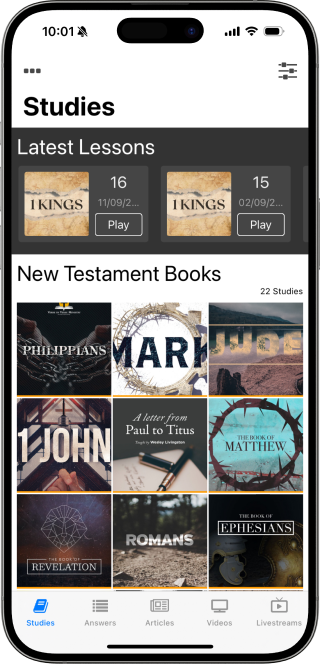
Access all of our teaching materials through our smartphone apps conveniently and quickly.